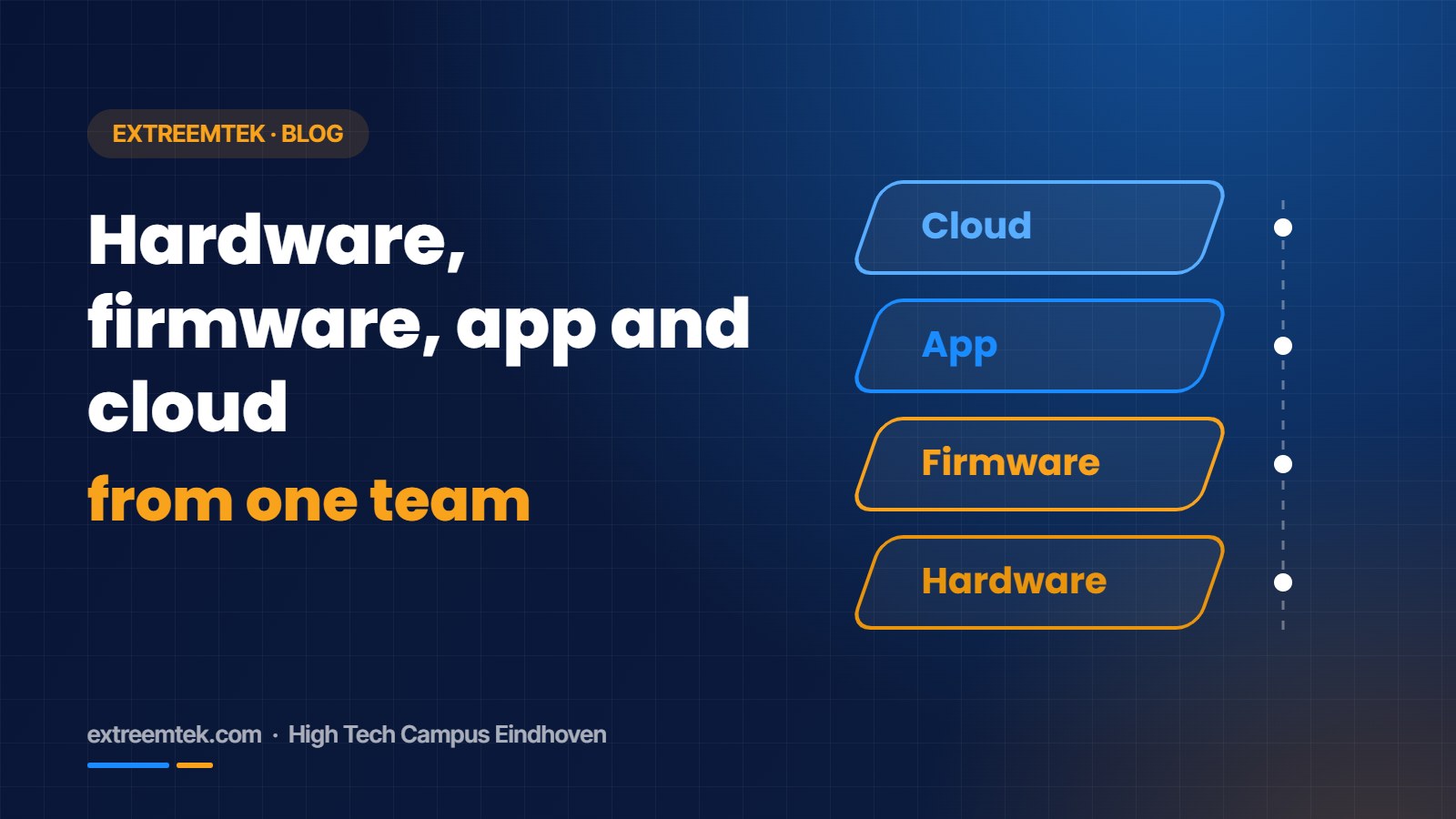
Short answer: a connected product has four layers that must work as one: the device hardware, the firmware that runs on it, the mobile or desktop app, and the cloud that stores data and sends updates. When one team designs all four, the interfaces between them are planned together, tested together and fixed by the same people. That usually means fewer integration bugs, faster releases and lower total cost than splitting the work across separate vendors.
The four layers of a connected product
Hardware
Sensors, chips, battery, antenna and enclosure. Decisions here fix power use, range and cost per unit.
Firmware
The embedded software on the device: sensor processing, power management, security and over-the-air updates.
App
iOS, Android, desktop or web apps that pair with the device over BLE or Wi-Fi and show the data to users.
Cloud
Accounts, data storage, dashboards, analytics, AI features and fleet-wide firmware updates.
Why the joins between layers cause most problems
Each layer can be built well on its own and the product can still fail. The risk sits in the interfaces: the Bluetooth protocol between device and app, the data format between app and cloud, and the update path from cloud back to the device. When different vendors own different layers, a bug at the boundary often turns into a discussion about whose side is wrong. With one team, the same engineers can trace the problem from the sensor to the dashboard and fix it in one place.
How one team builds all four layers, step by step
Discovery and architecture
We define the problem, users, data and target markets, then design the full system: which chip and radio, which data the device sends, how the app pairs, and how the cloud stores and updates everything.Risk-reduction sprints
We test the riskiest assumptions first, such as battery life, data rates or pairing reliability on different phones, before building features.Working prototype
A first end-to-end link on real hardware: device to firmware to app to cloud, so everyone sees real data early.MVP in short cycles
Firmware, app and cloud are developed in parallel with shared priorities, regular demos and shared code access.Testing and certification
Integration testing across devices, phone models and OS versions, plus the security and certification work your markets require.Launch, updates and scale
Secure deployment, over-the-air firmware updates, monitoring, security patches and new features as the user base grows.
One team vs separate vendors
| One end-to-end team | Separate vendors per layer | |
|---|---|---|
| Accountability | One team owns the whole product | Each vendor owns its own part |
| Interfaces | Designed and tested together from day one | Agreed in documents, tested late |
| Bug fixing | Traced end to end by the same engineers | Often slowed by handovers between vendors |
| Coordination | Handled inside the team | Handled by you |
| Hourly rate | Can look higher | Can look lower per vendor |
| Total cost and time | Usually lower, with fewer integration surprises | Often higher once rework and delays are counted |
Swipe the table sideways to see every column.
Separate vendors can make sense when one layer is already finished and stable, for example a proven device that only needs a new app. Even then, the new team must understand the firmware and cloud well enough to work with them.
Example: the RyseUp wellness ecosystem
For a European client, ExtreemTek built RyseUp, a €2 million connected wellness ecosystem. One team delivered the iOS and Android apps, desktop apps, BLE and Wi-Fi connectivity, cloud services and an online store. Learn more about our IoT and connected products, BLE and connected device app development and cloud and backend services, or read how to choose an IoT development partner.
FAQ
What does end-to-end IoT development mean?
End-to-end IoT development means one team designs and builds every layer of a connected product: the hardware, the firmware, the mobile or desktop apps and the cloud platform, including the interfaces between them and updates after launch.
Why use one team for hardware, firmware, app and cloud?
Most problems in connected products happen at the boundaries between layers, such as the Bluetooth link between device and app. One team designs, tests and fixes those boundaries together, which usually reduces integration bugs, delays and total cost.
Can ExtreemTek work with hardware we already have?
Yes. We can take over an existing device and build or modernise the firmware, apps and cloud around it, or improve an existing app that has connection problems.
Which connectivity options do you work with?
Bluetooth Low Energy (BLE) and Wi-Fi are the most common in our projects, combined with iOS, Android and desktop apps and cloud back ends for data, accounts and over-the-air updates.
Where is ExtreemTek based?
ExtreemTek is based at the AI Innovation Center on the High Tech Campus in Eindhoven, the Netherlands, and works with clients across Europe.
ExtreemTek newsletter
Get practical IoT and AI engineering tips in your inbox
Guides, checklists and lessons from real product builds. No spam, unsubscribe anytime.
Read our privacy policy.
